
Table of Contents
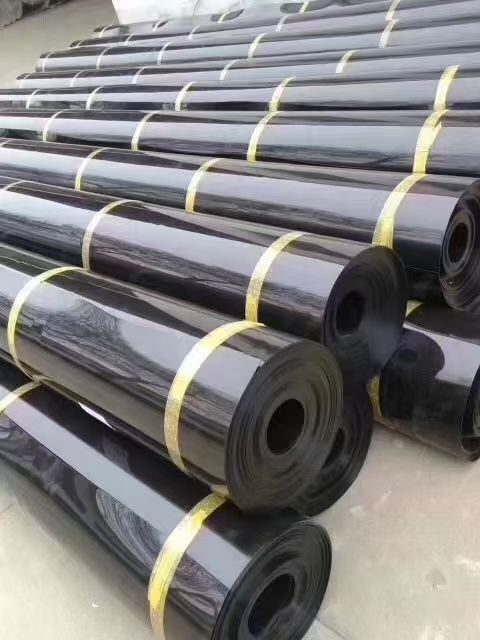
1. What the geotextile has to do
In most projects the nonwoven layer performs one of four jobs: separation between two different soils, filtration behind a drainage path, drainage in its own right, or protection of a geomembrane against puncturing aggregate.
Those four jobs load the fabric differently. A separation layer under a road sub-base mainly needs tensile strength and elongation; a protection layer over a liner mainly needs puncture resistance and thickness.
2. Mass per unit area: the first specification line
We produce staple-fibre needle-punched and polyester-filament nonwoven geotextile at 200, 300, 400, 500 and 600 g/m². The heavier grades are not automatically better: an over-heavy fabric costs more, ships heavier and can be harder to handle on a slope.
200–300 g/m² suits separation and light filtration under pavements and landscaping. 400–500 g/m² is the common range for landfill capping, reservoir protection layers and drainage trenches. 600 g/m² is used where the fabric is the protection layer over a geomembrane under coarse drainage stone.
3. Fibre type: staple fibre versus polyester filament
Staple-fibre needle-punched fabric has a shorter, denser fibre structure and is widely used for filtration, separation and protection. Polyester filament fabric uses continuous filaments, which gives higher tensile strength at the same mass and better resistance to installation damage.
For a drainage or protection layer over a large area, filament fabric often allows a lighter grade to do the same job. For filtration behind a retaining structure, the pore structure of a needle-punched staple fabric is usually the deciding factor.
4. Roll width and installation
Roll width runs to about 6 m depending on grade, which reduces overlap losses on large areas. Overlap width, seaming method and the amount of tension applied during installation all change the effective performance, so they belong in the specification alongside the mass per unit area.
If you are unsure which grade fits, send the application, the soil or aggregate type and the design life, and we will propose a grade rather than quote the cheapest one.