
Table of Contents
1. What a GCL is
A geosynthetic clay liner is a layer of sodium bentonite held between geotextile layers. When water reaches the bentonite it swells and forms a low-permeability barrier, and because the bentonite can migrate slightly it closes around small punctures.
GCL is normally used as a composite barrier beneath an HDPE geomembrane, or on its own in low-head applications such as landscape ponds and canals. Roll sizes depend on the product and the order; ask for the technical data sheet for the exact dimensions.
2. Overlaps and direction
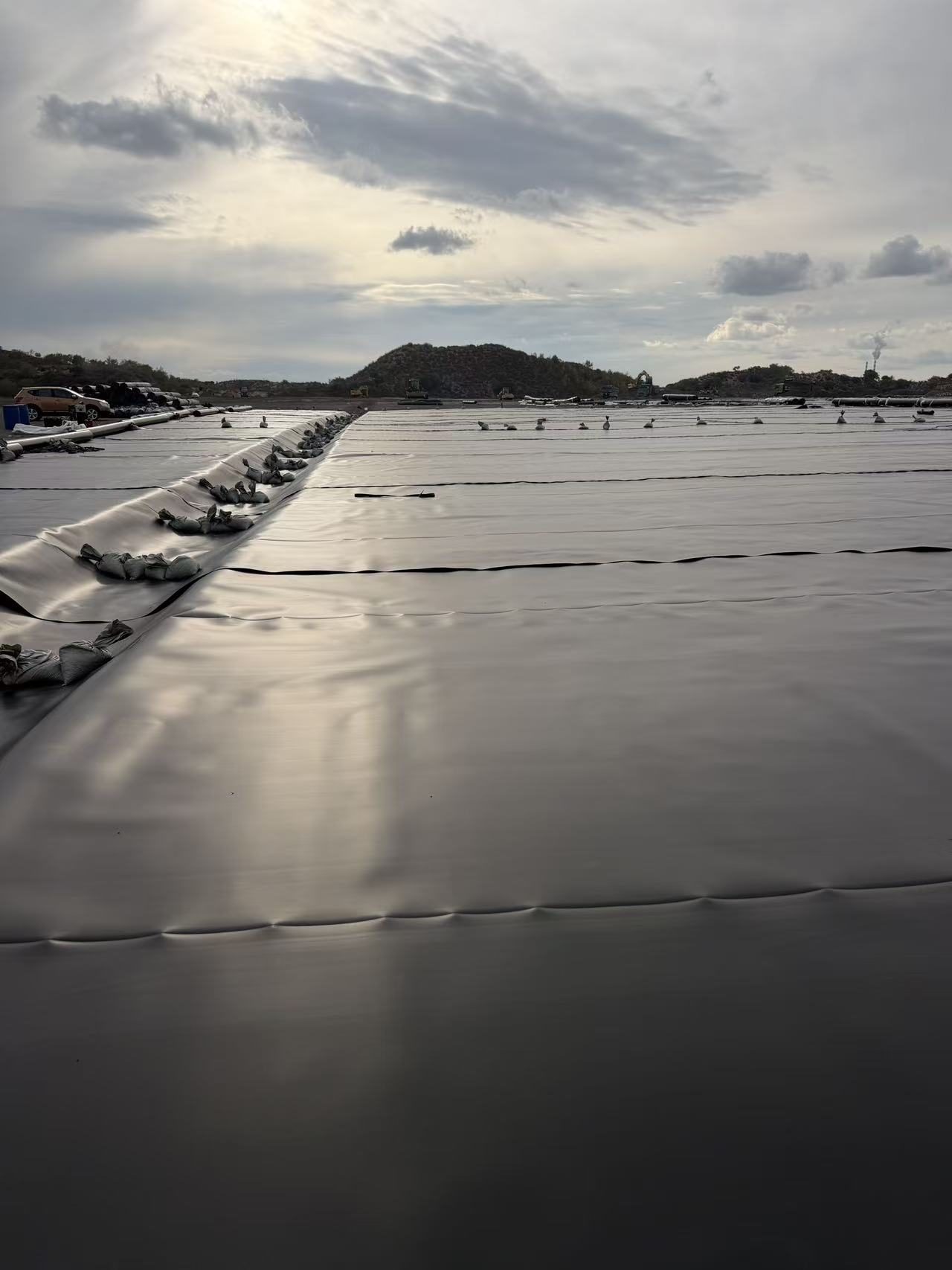
Panels are laid with a defined overlap — commonly 150–300 mm depending on the product and the slope — and the overlap direction must follow the slope so that water running down the slope does not run into the seam.
On slopes, panels are anchored in an anchor trench at the top before the next panel is unrolled. Walking on an unhydrated GCL should be kept to a minimum, and the material should not be dragged across the prepared surface.
3. Bentonite paste at the seams
Granular bentonite or bentonite paste is placed in the overlap to make sure the seam has enough material to swell and seal. Without it, the overlap relies only on the edge of two panels and is the first place to leak.
Seams should be checked before the geomembrane or cover layer is installed. On a landfill base, the GCL is usually inspected together with the liner and the drainage layer as one build-up.
4. Hydration and weather
Hydration happens after installation, from the subgrade, from the cover soil or from water introduced deliberately. Until then the material must be protected from rain that would cause uneven swelling, and from wind that can lift panels.
If the GCL will stay exposed for a long period, tell us at the quotation stage: the cover layer and the installation sequence need to be planned together, not added later.