
Table of Contents
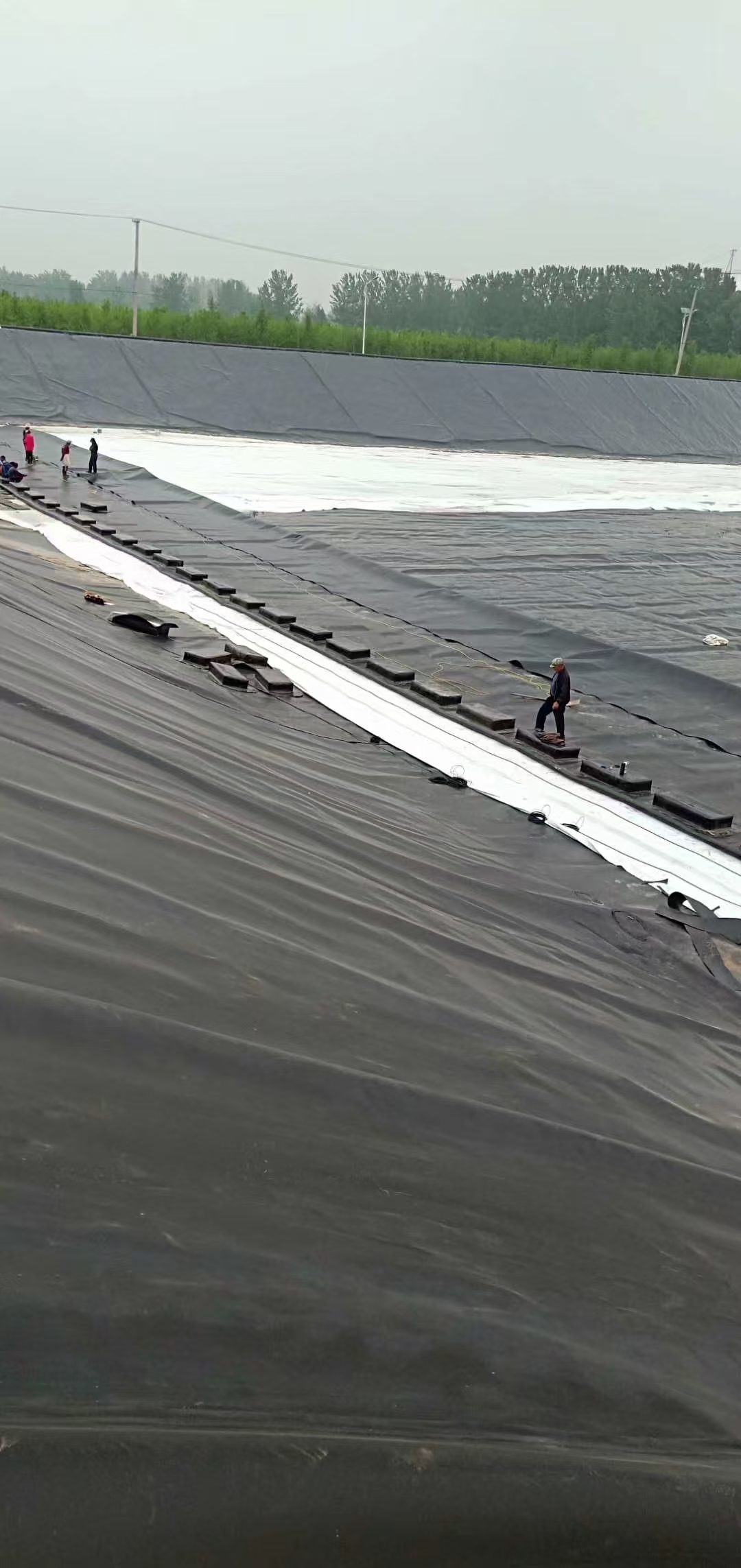
1. The typical build-up
A conventional base lining from the subgrade upwards is: prepared subgrade, GCL or compacted clay liner, HDPE geomembrane, protection geotextile, and then the drainage layer with leachate collection pipes.
On side slopes the same sequence applies but the membrane is usually textured to raise friction, and the protection layer has to resist sliding under the drainage aggregate.
2. Why the membrane is usually 1.5–2.0 mm
Landfill base lining normally uses 1.5 mm or 2.0 mm HDPE. The thicker gauge is chosen for puncture resistance against the drainage stone and for the longer service life expected of a containment facility.
The membrane is not the only barrier in the system: the clay or GCL layer beneath it provides a second, low-permeability line of defence, and the two behave differently under settlement.
3. Protection above the liner
A nonwoven geotextile of 500–600 g/m² is commonly placed over the membrane before the drainage stone is spread. Its job is to stop the stone puncturing the liner during placement and during later settlement.
Where the drainage layer is a composite drainage net rather than stone, the geotextile is usually bonded to the net and the protection function is built into the product.
4. Welding and testing
Seams are the weak point of any lining system. Panels are welded, the weld is checked visually and by non-destructive testing, and test samples are taken for destructive testing. A 5.8 m roll width reduces the number of seams to test on a large cell.
We supply mill test reports with each batch and can discuss welding parameters for the gauge you specify. Construction quality assurance should be carried out by the installer and, where required, an independent CQA inspector.